Siege of La Rochelle
The Siege of La Rochelle (1627–1628) is the climactic military and political event of Alexandre Dumas's The Three Musketeers, serving as the backdrop against which the novel's personal vendettas, court intrigues, and the final confrontation between Cardinal Richelieu and the Duke of Buckingham unfold. It is not merely a historical setting but a narrative engine that drives the fates of the four friends, tests their loyalties, and provides the stage for the assassination of Buckingham and the poisoning of Constance Bonacieux.
Causes and Background
The siege was the culmination of Cardinal Richelieu's grand political design to destroy La Rochelle, the last major stronghold granted to the Huguenots by Henry IV. Dumas explains that the city was "the focus of dissensions and ambition," a place where "Spaniards, Englishmen, and Italian malcontents, adventurers of all nations, and soldiers of fortune of every sect" gathered. Its port was the last in France open to the English, and closing it was essential to completing the work of Joan of Arc and the Duc de Guise. The cardinal's motives, however, were not purely political. Dumas reveals that alongside these "views of the leveling and simplifying minister," there were "the lesser motives of the amorous man and jealous rival." Richelieu, who had loved the queen, saw Buckingham as a rival who had "cruelly mystified him" in the affair of the diamond studs. The siege thus became a personal vendetta: "Richelieu knew that in combating England he combated Buckingham; that in triumphing over England he triumphed over Buckingham." On the other side, Buckingham was equally driven by private passion, seeking to enter France as a conqueror to win a look from Anne of Austria. The real stake of this war between two great kingdoms, Dumas concludes, was "simply a kind look from Anne of Austria."
What Happens
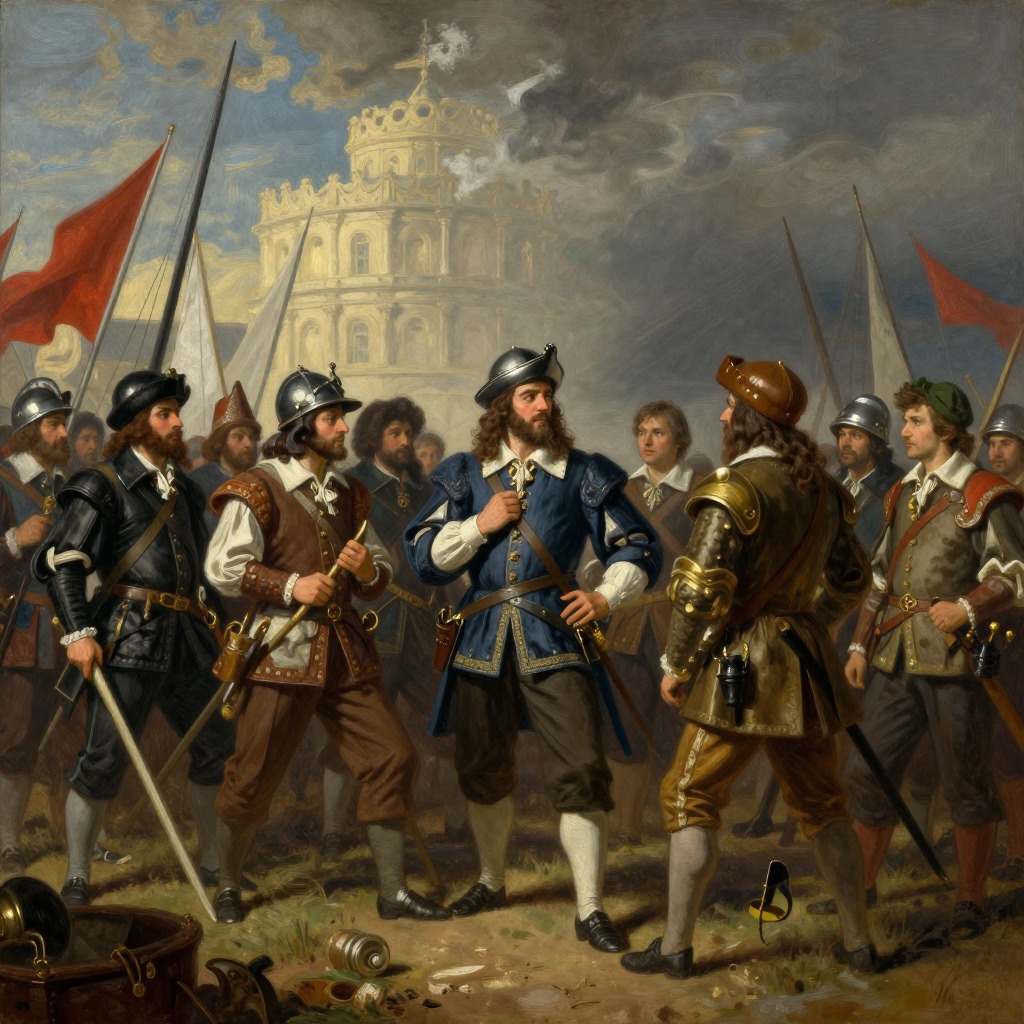
The siege dominates the latter half of the novel, beginning with the arrival of d'Artagnan and his company at the camp before La Rochelle on September 10, 1627. The English, under Buckingham, had already landed on the Isle of Re, surprising the Comte de Toiras and establishing a foothold. The French army, commanded by the king and the cardinal, besieged the city itself. The narrative focuses on the personal experiences of the four friends within this larger conflict. D'Artagnan, separated from his Musketeer comrades, faces an assassination attempt by two soldiers hired by Milady, an ambush he survives by feigning death and capturing one of the attackers. The four friends are reunited when the king arrives at the camp with his Musketeers, and they soon engage in the famous wager to breakfast in the Bastion Saint-Gervais, a daring exploit that wins them glory and allows them to secretly plan their countermeasures against Milady. The siege also provides the setting for the cardinal's clandestine meeting with Milady at the Red Dovecot inn, where he commissions her to go to London and either negotiate with Buckingham or arrange his assassination. The siege itself is described as a slow, grinding affair, with the cardinal's great dyke slowly starving the city. The climax of the siege narrative is the assassination of Buckingham in Portsmouth, which removes the Rochellais's last hope of relief and ensures the city's eventual surrender.
Consequences and Aftermath
The siege's outcome is decisive for both the historical and personal plots. La Rochelle, "deprived of the assistance of the English fleet and of the diversion promised by Buckingham, surrendered after a siege of a year" on October 28, 1628. The king made his triumphant entry into Paris on December 23 of the same year. For the four friends, the siege's end marks a period of transition. D'Artagnan, having proven his worth, is given a lieutenant's commission in the Musketeers by the cardinal. Porthos leaves the service to marry the wealthy Madame Coquenard. Aramis, after a journey into Lorraine, disappears to enter a convent. Athos remains a Musketeer under d'Artagnan's command for several years before also retiring. The siege thus serves as the crucible that forges the friends' final fates, separating them after their years of shared adventure. The cardinal's political triumph is complete, but the personal cost—the death of Constance Bonacieux, poisoned by Milady during the siege—leaves a permanent scar on d'Artagnan, ensuring that the novel's conclusion is tinged with melancholy despite the outward success.